
25 October: a crash test, a lab for tests with proven answers, and our Colab cards measured
This is the first of the daily issues: one email a day, with an article for each piece of the day’s work worth reporting. Today has three.
In this issue:
- We killed a machine mid-write. The log survived, but the kill didn’t test the fix
- A lab for tests whose answers are proved first
- What each Colab card is, from the receipts
We killed a machine mid-write. The log survived, but the kill didn’t test the fix
Section titled “We killed a machine mid-write. The log survived, but the kill didn’t test the fix”Attestia is one of the studio’s three proof products. Its event store keeps a log as a plain file, one event per line. Each event carries the hash of the one before it, so the events form a chain. If the chain is broken anywhere, the store refuses to open. That’s on purpose: a log you can’t trust is worse than no log.
We want to use that store as the run log for experiments on rented machines, and rented machines vanish. So before trusting it, we tried to break it.
The bug
Section titled “The bug”We found the problem on our own machine first, before spending anything. A writer that’s killed partway through writing a line leaves a torn last line: half an event, with no line ending. Then:
- A new writer opens the store. It skips the torn line, checks the chain up to the last whole event, and opens.
- Its first new event is written straight after the torn fragment, on the same line, because nothing put a line ending in between.
- The next time anything opens the store, it skips that glued line too, so the new event is gone. The event after it now points at a predecessor that isn’t there, and the chain is broken.
- With checking on, which is the default, the store refuses to open at all.
So one crash followed by one honest restart turned a good log into one that wouldn’t open.
The fix
Section titled “The fix”The fix is small. When the store opens a file that doesn’t end in a line ending, it writes one before its first new event. The torn fragment stays in the file on a line of its own and is skipped every time. Nothing is cut off or rewritten, so the store keeps its rule that the file only ever grows.
A real kill
Section titled “A real kill”Then we tested it for real, on a rented Colab machine running on CPU:
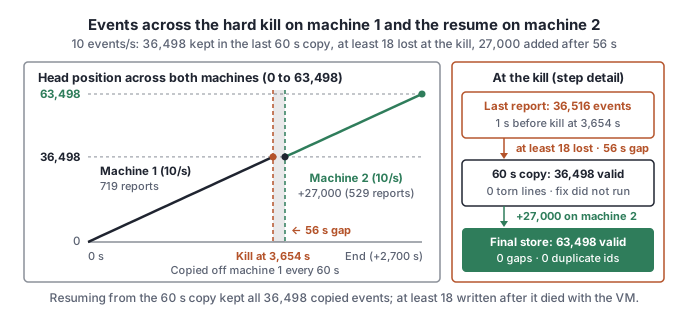
- a writer added 10 events a second for an hour;
- a copy of the store was taken off the machine every 60 seconds;
- at 3,654 seconds we killed the machine outright, with no warning to the writer;
- 56 seconds later, a fresh machine opened the last copy, with checking on.
The copy held 36,498 events, all valid. The new machine carried on writing and added 27,000 more. The final log held 63,498 events: a valid chain, no gaps and no duplicates. Its first 36,498 events are byte for byte the copy it started from, and its first new event links to the copy’s last.
What the kill didn’t test
Section titled “What the kill didn’t test”Two things were true that a headline would skip.
The fix never ran. The copy we resumed from ended on a whole line. There was no torn fragment for the fix to deal with. The run proved that a hard kill and a resume on a new machine work, but it didn’t prove the fix.
Some events died with the machine. Its last progress report, one second before the kill, counted at least 36,516 events. The copy held 36,498. So at least 18 events, about two seconds of writing, were on a machine that no longer exists. That isn’t a store bug: a resume from a copy can only have what the copy had. Anyone running a log on a machine that can disappear has to decide how much of it they can afford to lose, and copy at least that often.
The fix, tested on the same file
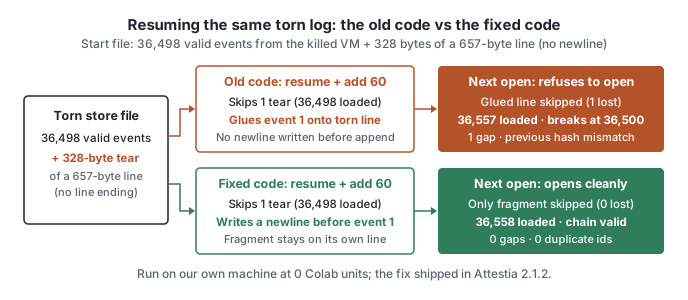
Section titled “The fix, tested on the same file”So we tore the file ourselves. We took the copy from the real kill and added the first 328 bytes of a real 657-byte event, with no line ending: exactly what a writer killed mid-line leaves. Then we resumed it twice, once with the old code and once with the fixed code, on our own machine.
- The old code skipped the fragment and opened. It added 60 events, and the first was glued onto the torn line and lost. The chain broke at position 36,500, and the store then refused to open.
- The fixed code skipped the fragment, added the same 60 events, and lost none. The chain was valid with no gaps, and the store opened again cleanly.
What it cost
Section titled “What it cost”| Step | Where | Cost |
|---|---|---|
| A short trial run of the whole procedure | Colab, CPU | 0.01 units |
| The real kill and resume | Colab, CPU | 0.14 units |
| The torn-file test, old code and fixed | our own machine | nothing |
Where it stands
Section titled “Where it stands”- Proven: a hard kill, and a resume on a fresh machine, with every event in the copy kept and the chain intact.
- Proven separately: the fix, on that same file with a torn line added by hand.
- Not proven: that a real kill tears a line, or how often. Ours didn’t.
- By design: events written after the last copy are lost with the machine.
The fix shipped today in Attestia 2.1.2, on npm and as a GitHub release. The run logs, both stores and the torn-file test are in the studio’s records, and every figure here was recounted from the store files themselves.
A lab for tests whose answers are proved first
Section titled “A lab for tests whose answers are proved first”Issue 29 ended with a decision: we stopped deciding anything about our critic from that test panel until we have a test whose answers are known for certain. This article is the start of that test.
reasoning-dataset-lab is a new public repository at mcp-tool-shop-org/reasoning-dataset-lab. It builds puzzles, quizzes and other tests. Its rules are the reverse of how a test is often made, where a model writes the items and someone checks them afterwards:
- Map first. Before any item exists, a
map.yamlsays what the dataset is: its axes (the skill tested, the kind of item, the difficulty, the subject, and the wrong answer each item is built to catch), every cell those axes make, how many items each cell gets, and the rules the finished set must pass. The map is hashed, so it can’t drift quietly. - Prove, then word. Code builds each item’s underlying problem and proves its answer before a language model
writes any prose around it. An item kind whose answer can’t be proved that way is marked
judged, and gets in only if judges from several model families all agree. - Show the gaps. A cell the generator can’t build yet stays in the map with a capacity of 0 and a reason. The map doesn’t shrink to make coverage look complete.
- Provenance on every item, so any item can be traced back to the map, the source material and the code that made it.
The first pilot map
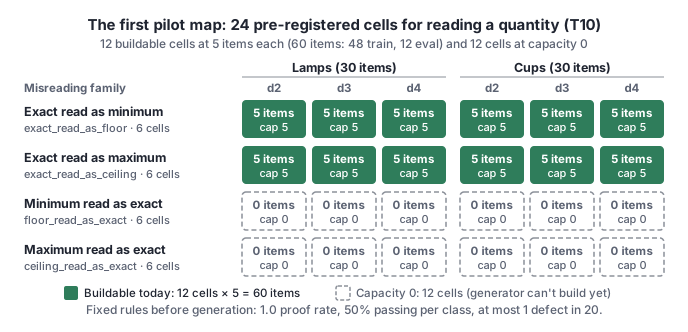
Section titled “The first pilot map”The first map, in the repository’s examples/, is for a single skill: reading a stated quantity correctly. Its wrong
answers are four kinds of misreading: an exact amount read as a minimum, an exact amount read as a maximum, and a
minimum or a maximum read as exact. The subjects are lamps and cups, at three difficulties.
That makes 24 cells. 12 are buildable today, with 5 items each: 60 items, 48 for training and 12 held out for evaluation. The other 12 are in the map at capacity 0, because the generator can’t build those misreadings yet.
The rules for the finished set were fixed before anything is generated:
- every answer key proved (a proof rate of 1.0);
- at least half the items passing in each class;
- a sample of 20 items read by a person, with at most 1 defect.
Where the lab stands
Section titled “Where the lab stands”The repository has a map checker, the project files and their fingerprint, and, as of today, the first part of the pilot: the interface every generator follows, and an adapter that drives the studio’s existing puzzle generator unchanged. No pilot items have been built yet. The pilot’s first batch, with its numbers and a sample of items, is the next step.
What each Colab card is, from the receipts
Section titled “What each Colab card is, from the receipts”We rent GPU time on Google Colab in windows: a session on one card, booked and closed by a script that keeps a receipt of everything it did. Before planning the next set of measurements, we read every receipt we have, 21 windows and the probes around them, and wrote down what each card actually is. Every value below comes from a receipt. Where no receipt measures something, we say so.
The cards
Section titled “The cards”| Card | Memory | Rate (units an hour) | Sessions | What went wrong |
|---|---|---|---|---|
| A100, 40 GB | 40,960 MiB | 5.3 | 62 or more | 3 sessions lost mid-run on 23 October, plus one machine dropped mid-download and one session pruned earlier; 3 full four-hour windows with no loss |
| A100, 80 GB | 81,920 MiB | 6.77 | about 8 | 1 session ended at 132 seconds when we stopped it (from 2 windows; the other ran 10,732 seconds clean) |
| RTX PRO 6000 (G4) | 97,887 MiB | 8.9 | about 9 | none (from 2 windows); one ran 8,680 seconds clean |
| L4 | 23,034 MiB | 1.54 | about 8 | only one window used it |
| T4 | not measured | about 1.07, worked out, not read | assigned 6 times | never used |
| H100 | — | — | never assigned | refused 5 times, “Service Unavailable” |
| CPU (standard) | 12.3 GB of RAM free | 0.08 | 41 or more | the download check rejected 5 of 52 tries as too slow |
The plan allows up to 20 sessions at once: 3 each of the five GPU cards we can be assigned (the two A100s, the RTX PRO 6000, the L4 and the T4) and 5 CPU machines. The next request is refused.
Faster isn’t always cheaper
Section titled “Faster isn’t always cheaper”On the same job, a critic model checking items:
- the RTX PRO 6000 took a median 46.7 seconds a call against the 40 GB A100’s 66.5: about 1.4 times as fast, at 1.68 times the price;
- the 80 GB A100 ran the model 1.11 times as fast as the 40 GB one, at 1.28 times the price, with identical output on all 178 calls compared.
So for that job, the cheaper card cost less per result. That holds for that job only. Another model or another size can change it.
What no receipt measures yet
Section titled “What no receipt measures yet”- the time to the first token, on every card;
- how fast a model downloads through Ollama (no receipt has an Ollama log);
- how long a card takes from the request to ready;
- almost everything about the T4, which has never run a job, and the L4, which ran one window.
Those gaps are the reason for the next sweep, C2, which measures the cards the same way: the largest model context each holds, the speed at several prompt lengths and loads, and the throughput of small embedding models.
Licences first
Section titled “Licences first”Before a model’s first window, it needs an entry in our licence registry, read at its source. Six of the models in the C2 sweep had none, so we read them: phi3.5 (MIT), nomic-embed-text-v1.5 (Apache-2.0), bge-base-en-v1.5 (MIT), bge-reranker-v2-m3 (Apache-2.0), nli-deberta-v3-base (Apache-2.0) and Qwen3-Embedding-0.6B (Apache-2.0). No card or linked page restricts our use. Only phi3.5 ships a licence file; the other five rest on the licence their model card names. Each entry keeps a hashed snapshot of the page and an archive.org copy.
Get each issue by email or RSS: Subscribe