
A win that didn't replicate, and a test that couldn't see
The studio builds training data with local language models. A writer drafts each item and a critic checks it: it reads the material and a statement, and gives one of three verdicts, supported, unsupported or cannot_tell. When its verdict differs from the item’s label, the item is refused. A false refusal throws away a good item.
Issue 28 found that the writer is told what each label means and the critic isn’t. It ended with a plan: test the critic’s prompt as it is (A) against the same prompt plus the writer’s definitions (B), on 30 blind-graded items, with the decision rule fixed before any run. This issue reports that test.
The rule, written first
Section titled “The rule, written first”Of the 30 items, 23 were graded sound: both blind graders and the item’s label agreed, and nobody flagged it unclear. The other 7 were ambiguous and counted apart. Each prompt ran on every item with three seeds, so 69 calls on sound items per prompt.
B would be recommended only if both held:
- (a) B’s false refusals on sound items are at most half of A’s;
- (b) B accepts at most one more of the items whose label the graders contradict.
Passed by one call
Section titled “Passed by one call”The first run, on seeds 0–2, gave A 9 false refusals and B 4. Half of 9 is 4.5, so (a) held, by one call. (b) held at its limit. The rule said B.
One call is a thin margin, so we ran it again on seeds 3, 4 and 5, with nothing else changed.
Failed on the rerun
Section titled “Failed on the rerun”On the new seeds A refused 9 again, and B refused 7. That’s well over half, so (a) failed. Pooled over all six seeds, A refused 18 of 138 calls and B 11. Half of 18 is 9, and 11 is more, so the pooled result fails too. The rule says keep A.
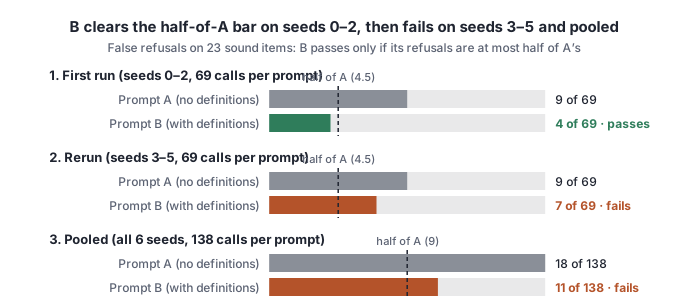
The first run wasn’t wrong. It was a favourable draw: two items, P20 and P26, happened to go B’s way more often on those three seeds than on the next three.
A trade, not a fix
Section titled “A trade, not a fix”Splitting the refusals by the item’s true label shows what the definitions actually do:
| Sound items, by label | Calls per prompt | A refused | B refused |
|---|---|---|---|
| cannot_tell (10 items) | 60 | 12 | 0 |
| supported (7 items) | 42 | 5 | 5 |
| unsupported (6 items) | 36 | 1 | 6 |
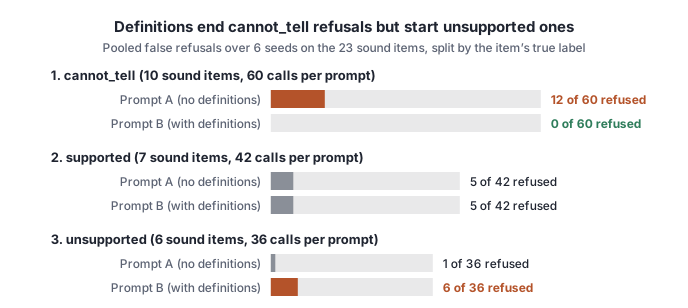
A’s main error is calling a silent item unsupported. The definitions fix that completely. But B then calls some unsupported items cannot_tell, an error A almost never makes. B moves the line between the two labels; it doesn’t make the critic better at both.
Six items carried everything
Section titled “Six items carried everything”Then we looked at where the refusals were. On 17 of the 23 sound items, neither prompt refused once: 0 of 102 calls each. Every refusal, in both prompts and all six seeds, was on the other six.
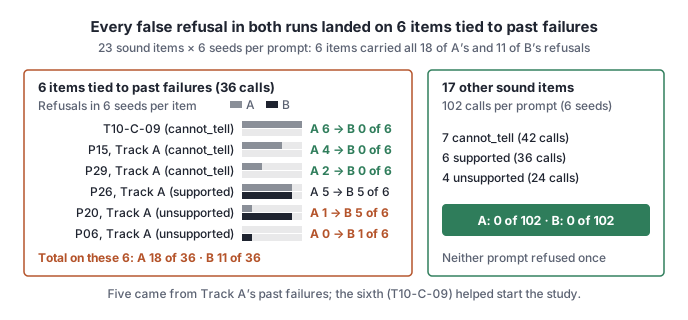
Those six weren’t a random draw. Five came from an earlier study, Track A, and were picked for this panel because the old prompt had already failed on them there: three it refused, two it flipped on between runs. The sixth, T10-C-09, came in under a rule that took every item of its kind from a later run, but its refusal in that run was one of the failures that started this study.
So the test was built, deliberately, around the old prompt’s known failures, and the new prompt was designed to fix those failures. That’s a fair way to find out whether a fix works on the cases it was made for. It can’t tell you whether the fix helps or hurts anywhere else, and the 17 other items gave no signal either way.
More seeds won’t change that. Antigravity, the outside model we work with, worked through the numbers before the rerun came back: almost all the spread in this result comes from differences between items, not from run-to-run noise, so rerunning the same 23 items barely narrows it. Its estimate was that doubling the seeds would shrink the uncertainty by only about 6%.
What we’re doing about it
Section titled “What we’re doing about it”We’re not deciding anything about the critic from this panel. The old prompt stays, and no run that the critic scores is being started. That hold lasts until we have a test whose answers are known for certain, rather than graded after the fact.
The lesson we’re taking is simple: a test built from your failures can only tell you about those failures.
The raw results, the scoring scripts and the graded panel are in the studio’s research library, and every figure here was recounted from the critic’s own output files.
Get each issue by email or RSS: Subscribe