
Which local model can check claims for offrig?
⚠ Provisional (2026-10-10): these verifier numbers were measured on synthetic gold, claims and labels written by Claude, not checked against human labels. They are not results until re-measured on a public human-labelled set. Further runs on this gold are stopped.
The question
Section titled “The question”offrig’s verify step asks a local model whether a claim about code is supported by the evidence. We needed a
default model that is rarely fooled, rarely abstains and is accurate when it does decide. The rule was fixed
before any run:
- the upper end of the 95% interval for false accepts is under 0.10;
- it abstains on at most 20% of claims;
- its balanced accuracy on the claims it decides is at least 0.80;
- no claim is left missing (truncated or unusable).
Two kinds of claim are checked separately: grounded (is this sentence about the code true?) and reasoning (does this conclusion follow from the change?). The gold set was built for this: every label was assigned blind, and a cross-family check found and fixed 2 wrong labels in 120.
What we found
Section titled “What we found”-
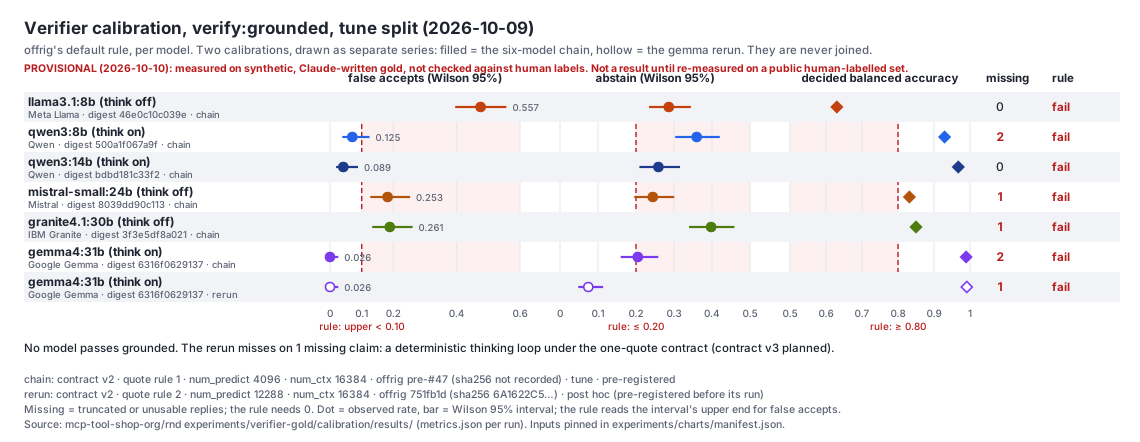
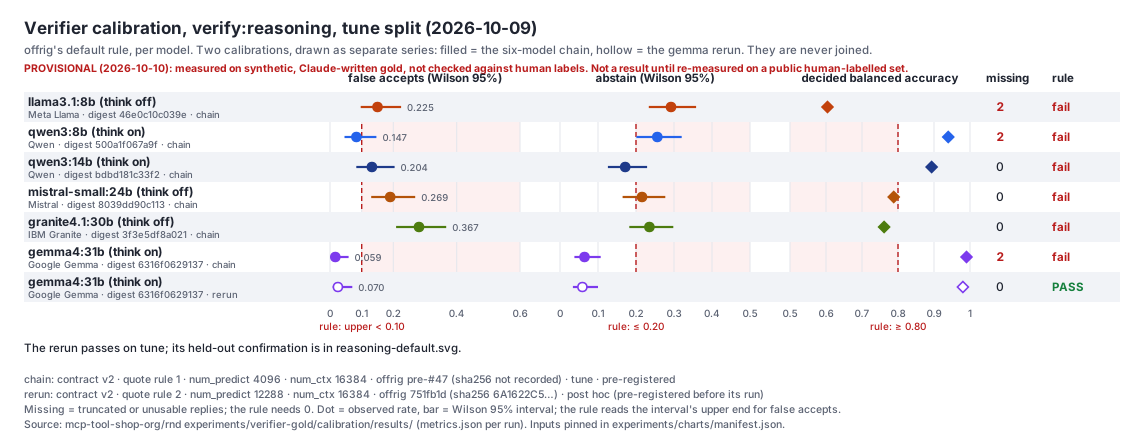
No model passed in the first six-model run. The models without thinking (llama3.1:8b, mistral-small:24b, granite4.1:30b) were fooled most. The thinking qwen3 models were fooled less but abstained too often.
-
gemma4:31b was fooled almost never, but missed on four replies cut off at the 4,096-token reply limit while it was still thinking.
-
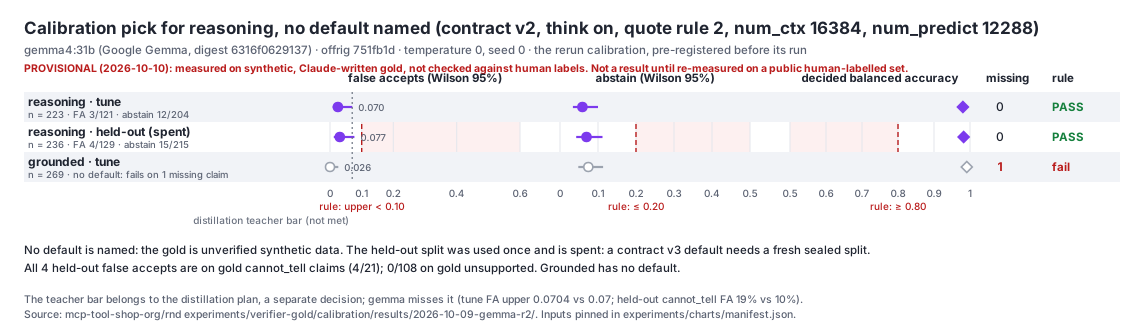
Rerun with a bigger reply budget (12,288) and offrig’s quote rule 2: reasoning passed on the tune split, then passed on the held-out split. On this gold that made gemma4:31b the calibration’s pick for reasoning claims. No default is named; that waits for the public-data re-measure.
-
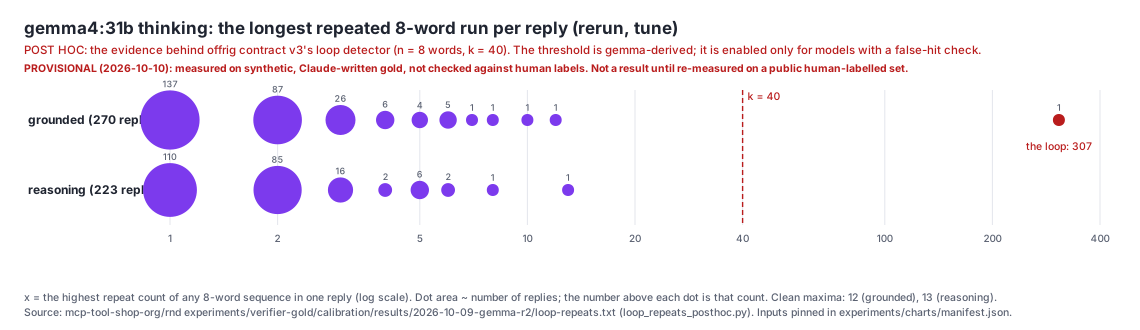
Grounded still has no default. One claim sent gemma into a thinking loop: it couldn’t choose which of two separate passages to quote, because the contract allowed only one quote. It repeated two lines 307 times. offrig’s next contract allows up to four quotes and adds a loop detector.
-
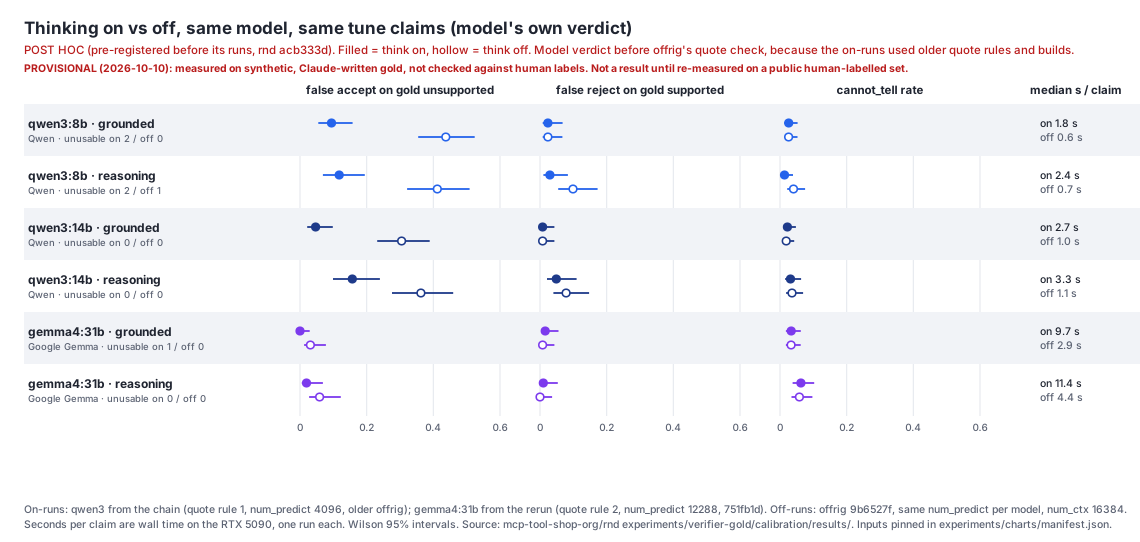
With thinking off, the same tune claims, post hoc: the qwen3 models accepted 3–6× more false claims, so thinking is doing real work for them. gemma4:31b lost little: it was 3.3× faster, with 4 false accepts of 128 instead of 0 on grounded claims. With thinking off, it passed the rule on grounded claims, the first grounded pass of any model. Because we chose to look at it after seeing the results, it names nothing until a held-out run confirms it (pre-registered, separate grant). On reasoning claims it narrowly failed with thinking off.
Caveats
Section titled “Caveats”- The two calibrations used different offrig builds, quote rules and reply budgets. They are separate results, never one run that improved.
- The held-out split for reasoning under this contract has now been used. A default under the next contract needs a fresh sealed split.
- All four held-out false accepts were on claims whose right answer is “cannot tell” (4 of 21). None of 108 false claims was accepted.
- No default verifier is named, and gemma4:31b is not chosen as a distillation teacher. On this gold it narrowly missed the stricter teacher bar.
- The loop detector’s threshold (40 repeats) was derived from this one model’s replies.
Receipts
Section titled “Receipts”mcp-tool-shop-org/rnd, experiments/verifier-gold/calibration/: the README’s pre-registrations and results
(rnd 1.1.4.3.28–1.1.4.3.37 and the thinking-off result), and results/2026-10-09-chain/, results/2026-10-09-gemma-r2/ and
results/2026-10-09-thinking-off/ (each run’s
manifest, metrics and verdicts). Chart inputs and their sha256 are in experiments/charts/manifest.json.