
How close to the beat and the note do the sung hymns land?
The question
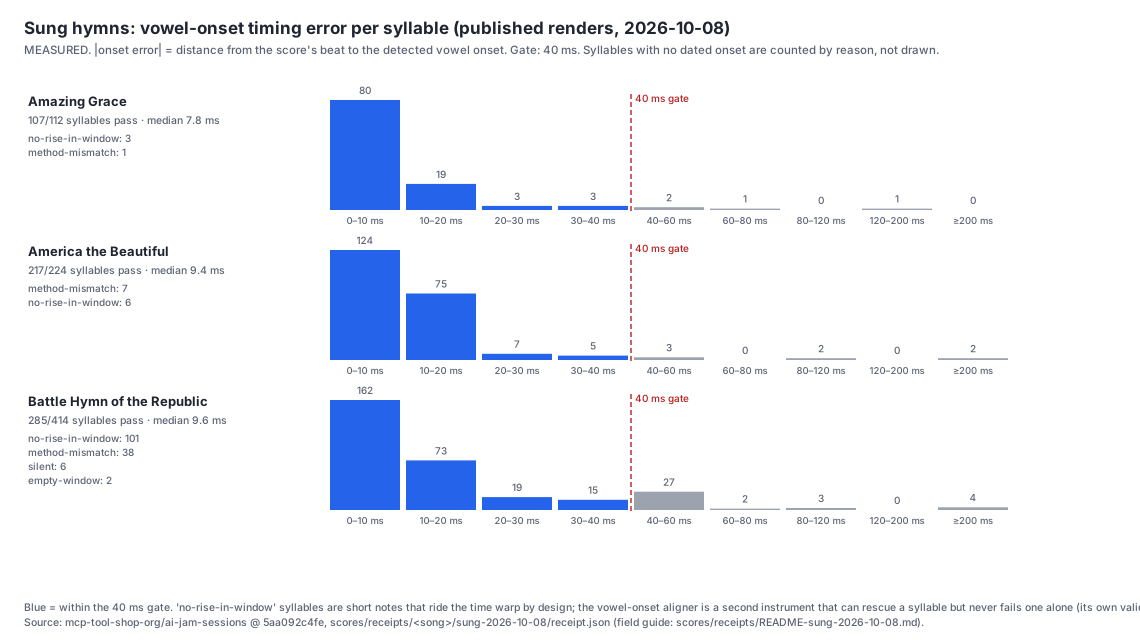
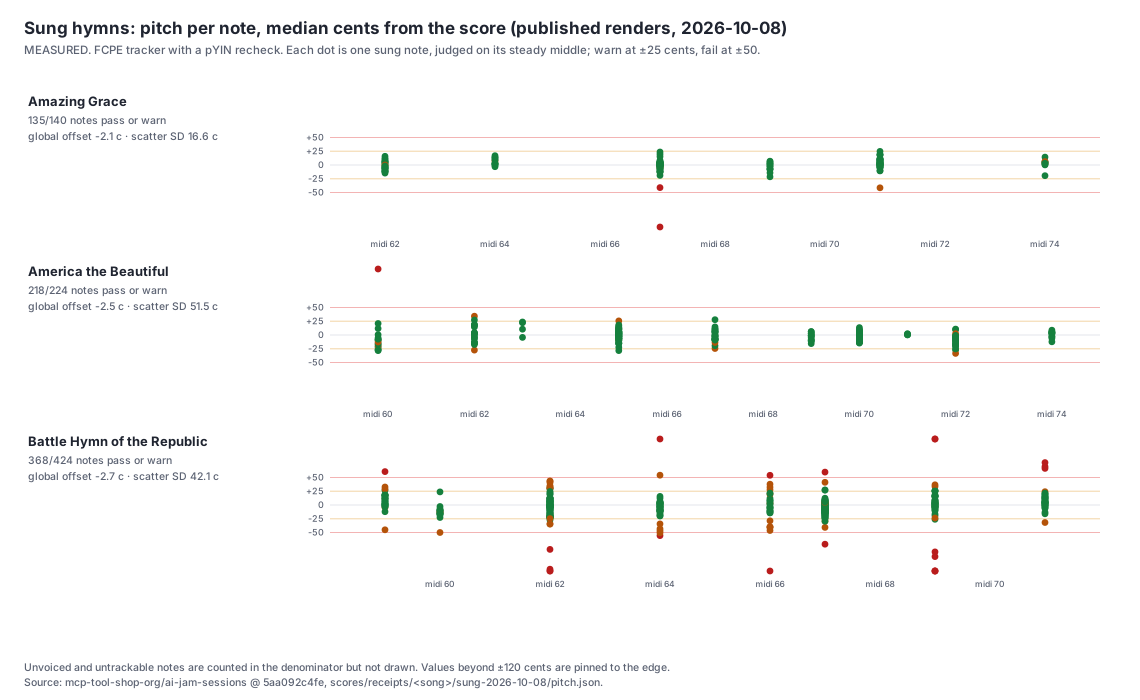
Section titled “The question”ai-jam-sessions renders hymns with a singing-voice model, then checks every syllable: does its vowel land on the beat (within 40 ms), and is each note in tune (within 25 cents to pass, 50 to fail)? How did the three published hymns do, and what limits the checks themselves?
What we found
Section titled “What we found”| hymn | timing: syllables passing | median / p90 onset error | pitch: notes pass or warn | scatter SD |
|---|---|---|---|---|
| Amazing Grace | 107/112 | 7.8 / 20 ms | 135/140 | 16.6 cents |
| America the Beautiful | 217/224 | 9.4 / 18 ms | 218/224 | 51.5 cents |
| Battle Hymn of the Republic | 285/414 | 9.6 / 45 ms | 368/424 | 42.1 cents |
- Timing is tight where it’s measured. Battle Hymn’s misses are mostly short notes (101 of them) that ride the time warp by design. There are also 38 disagreements between methods, 6 silent syllables and 2 empty windows.
- Pitch is centred: the global offset is −2.1 to −2.7 cents, but individual notes scatter. A pYIN recheck rescued 1, 1 and 12 notes.
- Phrases are picked whole from one take, ranked by intelligibility first, then pitch, then timing. Ranking timing first had made Amazing Grace worse (8 pitch fails became 14).
- Before the song, a sound check predicts the takes needed. It rendered one America phrase 3 times and said 4 takes, which matches what the exemplar needed (7 if both timing instruments must agree). Vowel-first words land early (about −62 ms) and stops and fricatives late (+51 and +47 ms), but the spread from render to render (29–82 ms) is too wide for a fixed correction. The answer is choosing takes, not shifting them.
- The one-voice gate catches only 3 of 20 marked “honks” in its evaluation. Its flags are good; its recall is low.
Caveats
Section titled “Caveats”- The forced aligner is not validated. It is the timing gate’s second instrument: it can rescue a syllable but never fails one alone. Its validation against a human-annotated corpus hasn’t run, pending corpus licences (Director, 2026-10-06), so its ±20 ms agreement band is provisional. It has gross errors of its own, up to 1.4 s on long phrases.
- The listening model (Qwen3-Omni, local) is advisory only. It heard 89% of Amazing Grace’s words and 75% of
America’s on the first renders, but it can fill in a famous line from memory, so it ranks takes and never
gates them. These first-render figures are prose in
docs/vocal-clock.md@ 99c0216, without committed receipts. - The sound-check figures come from one phrase and one voice, with 3 renders. An earlier detector-only version (589538e) is superseded.
- The artefact detector heads are built and tested but have no recorded results yet, so they aren’t charted.
Receipts
Section titled “Receipts”mcp-tool-shop-org/ai-jam-sessions @ 5aa092c (merging 836641ef9b):
scores/receipts/<song>/sung-2026-10-08/(receipt, pitch, plan, phrase scores, voice gate, mix, piano bed);scores/receipts/voice-gate-eval-2026-10-08/(the one-voice gate’s evaluation);scores/receipts/README-sung-2026-10-08.md(field guide);scores/receipts/america-the-beautiful/soundcheck.receipt.json@ 9b92862.
Every published figure reproduces from these files.