
Picking a writer model on rented GPUs
The studio is building a small local model whose job is to check other models’ claims: is this statement supported by this evidence, or not? To train it, we need thousands of practice rows, each a short piece of material with a statement and the right answer. We write those rows with larger open-weight models, and a second model, the critic, checks every draft before it’s kept.
Which model should do the writing? There were eight candidates. This issue covers night one of the pilot that picks between them: what we measured, what went wrong, and the method we’d use again. The screen’s results will be added here as updates when they land. → the plan
The setup, in brief
Section titled “The setup, in brief”- Eight writers, all open-weight: Qwen3.8-27B, Qwen3.6-35B-A3B, Granite-4.2-30B, Gemma-4-31B-it, DeepSeek-R1-Distill-Qwen-32B, Muse-Glimmer-30B, and NVIDIA’s Nemotron-3.5 Lightning-30B and Bolt-74B. Every one was checked against its licence before it went in.
- One critic per writer, never from the writer’s own family. Muse critiques every writer except itself; Lightning critiques Muse.
- Rented GPUs. Each “window” is a Colab session on one NVIDIA A100 with 40 GB of memory, paid in Colab compute units. An A100 costs about 5.3 units an hour. A CPU-only session costs about 0.08.
- Pinned models. Every model file is rebuilt from a fixed source revision and has to reproduce a recorded fingerprint (its sha256 hash) before it serves. When something went wrong, we always knew it wasn’t the model files. Lightning’s file was rebuilt four times and matched every time.
- Same settings for everyone: each model runs at its own model card’s recommended sampling and thinking settings, with a 32,768-token context and a 16,384-token limit on each reply.
Not every model fits a 40 GB card at those settings. Qwen3.6 fit at 8-bit precision, peaking at 36,022 MiB of 40,960, and wrote at about 90 tokens a second. Gemma fit with 4,943 MiB to spare, at about 28 tokens a second. DeepSeek-R1-Distill didn’t fit at 8 bits, so it will run a 6-bit build and be reported apart from the 8-bit writers.
Step 1: test the judge before it judges anything
Section titled “Step 1: test the judge before it judges anything”If the critic is wrong, every number downstream is wrong too, so the critic was tested first. The test is a known-answer set: 40 practice items whose right answers we wrote ourselves, plus 10 copies with a deliberate error planted in them. The bar was written down before any result came in:
- agree with the key on at least 36 of the 40 clean items;
- catch at least 80% of the planted errors;
- for a critic that samples randomly, like Muse, two runs with different random seeds may disagree on at most 4 of the 40.
Both passed. Muse agreed with the key on 38 and 37 of 40 across its two runs, caught all 10 planted errors, and its two runs disagreed on just 1 item. Lightning agreed on 38 of 40 and caught all 10.
The more useful finding was in the misses. On two items, a critic disagreed with our key and was right: both critics on one, Muse alone on the other.
- “Retries the upload up to 3 times” means up to 4 attempts in all, so “tried at most 3 times” isn’t supported. Our key said it was. Muse flagged it in both runs.
- “Apply every four weeks from March to September” fairly rules out January. Our key said you couldn’t tell. Both critics disagreed with it.
We replaced both items in version 2 of the set and changed nothing else. A calibration set can check the person who wrote it, so read the misses before blaming the model. Next time, the key will be written by two writers independently, or checked blind by a model from a third family, before it’s used. → the set and its errata
Step 2: thinking is most of the bill
Section titled “Step 2: thinking is most of the bill”Modern open models “think” before they answer: they write out reasoning that’s never shown to the reader, then the answer. That reasoning counts toward the reply limit and takes GPU time like any other output.
We logged every call through a small proxy that records token counts and timings. Qwen3.8’s first 13 calls show where the time went:
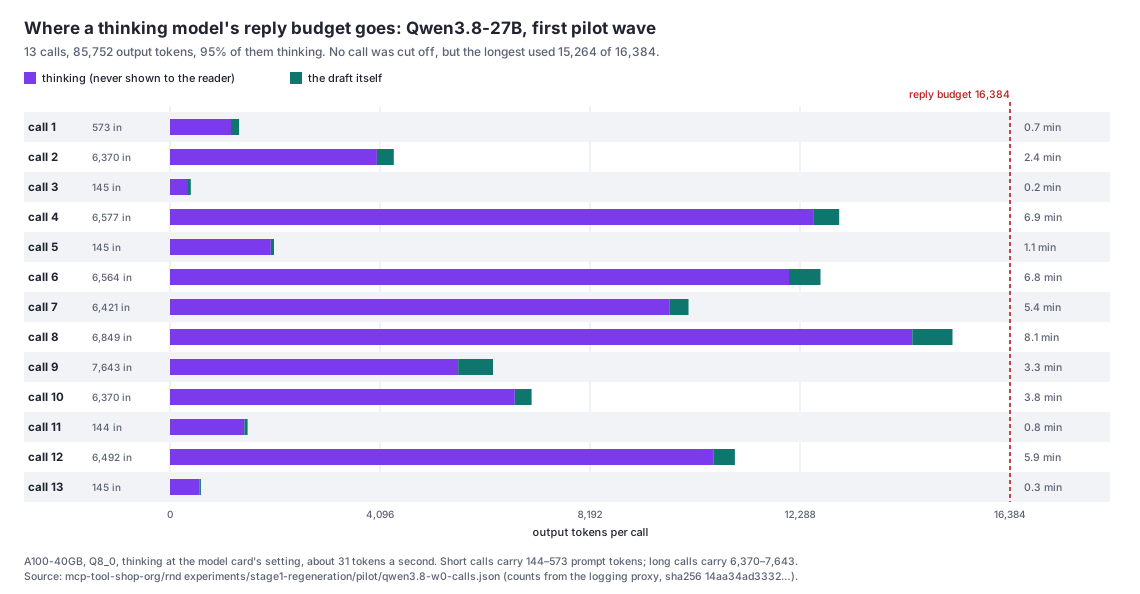
- 95% of the output was thinking: 81,372 of 85,752 tokens.
- The calls came in two shapes. Short prompts (144–573 tokens) got 405–2,030 tokens back, in under 70 seconds. Long prompts (6,370–7,643 tokens) got 4,364–15,264 back, at 2½–8 minutes each.
- Nothing was cut off, but the longest call used 15,264 of its 16,384 tokens. A model that thinks a little longer will start hitting the limit. A cut-off reply is reported as its own outcome, separately from a refusal, so running out of room isn’t confused with being wrong.
That changed the plan. Each practice row took about two calls: about 12,100 output tokens and about 6½ minutes per row (roughly 7 rows finished in those 46 minutes). Projected across the pilot as designed (8 writers, 20 practice rows each, with rewrites), and assuming every writer thinks about as long as Qwen3.8, it came to 147–175 units, against about 35 left that night.
So the pilot became a screen:
- every writer drafts the same 8 practice rows, plus 2 “twin” rows of a second kind, from one fixed list;
- every draft is critiqued once, and drafts the critic sends back get one rewrite;
- writers that drop 3 or more of their 8 are cut;
- writers that pass go on;
- with 8 rows per writer, the screen can tell “doesn’t work” from “works”. It can’t rank close writers finely, and the readout will say so.
And one number joined the readout: cost per accepted row. A writer that thinks for 12,000 tokens per row pays that on every row of the full dataset later, so cost is part of the choice, not just a budget line.
Step 3: long paid jobs fail, so design for it
Section titled “Step 3: long paid jobs fail, so design for it”This is where most of the money went. By the time the budget was raised at 19:44 UTC, 70.66 units had been spent, and about 38 of the first 71 didn’t buy the results their windows were opened for:
| What happened | Units |
|---|---|
| A long pilot window: the rig stopped receiving the job’s output, the job ran on unseen, and the window hit its cap without downloading anything | 14.03 |
| Colab reclaimed a machine 77 minutes into the job, with nothing saved off it | 12.81 |
| A connection hung at the first command with nothing running, and the session sat open for 35 minutes | about 3.2 |
| A check looked for a log line the server doesn’t print at its default log level, and stopped the window | 3.00 |
| Three failed starts: a missing setting, a machine dropped mid-download, and a module missing from a package | 5.29 |
None of these were the writers’ fault. They were our tooling, and how it dealt with machines and connections that failed. The method that came out of it, in the order we’d build it again:
- The job writes its own log, and the rig reads that file, never the live output stream.
- The stream between the rig and a Colab session can stop while the job keeps running. That’s how the long pilot window ran on unseen. It was the full 20-row design; by our projection it couldn’t have finished its first wave inside its cap, and it stopped without downloading, so its work was lost.
- So the job appends everything to a file on the machine, and the rig downloads that file every 2 minutes.
- Progress, stalls and “finished” are all judged from it.
- A download that dies partway never overwrites the good copy.
- Every finished model call is saved the moment it returns.
- Each call goes into a journal, keyed by a fingerprint of exactly what was asked.
- A resumed run replays the saved calls instead of asking the model again, and the job’s own logic rebuilds everything else from them.
- We tested it with a mock model in role-set’s tests: a run killed halfway and resumed gave every draft and every decision identical to an uninterrupted run, and no call ran twice. A separate check on the rig showed the saved calls survive the trip through the log byte for byte. It hasn’t yet had to rescue a real run.
- Every way a window can end downloads the results first: finished, stalled, out of time or at its spending cap.
- The cap starts the exit early enough that the download fits inside it.
- The window that lost 14.03 units had stopped at its cap without downloading.
- Caps count each window’s own spend.
- Two separate bugs. An early cap read the account balance, so one window was cut off by its neighbour’s spend. Later, two windows that opened at the same moment each measured both sessions’ combined rate as their own, and stopped at about half their real budget.
- Each cap now counts its own rate times its own runtime, which fixed the first. The rate is read under a lock, so two windows can’t open at the same moment, which fixed the second.
- Set up each model just before it’s needed, not all at the start.
- The reclaimed window’s log showed 49 minutes setting up three of its four models; its last 28 minutes were never seen.
- Now a writer is set up right before its own drafts and the critic right before the first critique. A loss costs at most one setup.
- Test each new kind of window on the cheapest machine first.
- Before trusting the new file-based watcher, we ran a fake job on a CPU-only session that went silent on the stream and then hung.
- The watcher saw it finish from the file, downloaded the results in 2 seconds, and closed the session.
- The two tests together cost 0.03 units.
The rule underneath all six: assume the machine can vanish at any minute, and make sure that minute costs only the work in flight.
Step 4: a blind second opinion on the budget
Section titled “Step 4: a blind second opinion on the budget”When the budget was raised to 150 units, we wanted an outside view on how to spend the remaining 79. The catch with asking for advice is that you tend to anchor on it, or the adviser anchors on you. So:
- We wrote and committed our own allocation first, then sealed it.
- Argon, the studio’s outside reviewer, got only the measured facts: setup times, speeds, tokens per row and the failures so far. It didn’t see our plan.
- We compared the two answers against the sealed version.
Argon’s plan was better in three places, and we took them:
- pair Lightning and Muse in one window, each critiquing the other, which saves two model setups;
- set up models lazily (point 5 above);
- fold one rewrite into the screen itself, so writers that pass don’t need a second window.
We kept one of ours, and corrected one of Argon’s assumptions:
- The second-critic check. A second critic re-scores a blind sample of each writer’s drafts, to see whether Muse favours writers that sound like it. It stays as a gate before any writer goes further.
- The correction: Argon assumed Qwen3.8’s lost window could be resumed. It couldn’t: that window ran before the call journal existed.
What’s next
Section titled “What’s next”The screens are running tonight in this order:
- Granite;
- Qwen3.6 and Bolt;
- Lightning and Muse;
- Qwen3.8 and Gemma.
DeepSeek-R1-Distill waits for another day. Its 6-bit build hasn’t been made yet (the one setup step we haven’t timed), and it sits in its own 6-bit group.
For each writer, the readout will give:
- how many of its 8 rows were accepted, dropped or cut off;
- its twin results;
- its tokens and units per accepted row;
- its share of thinking;
- “cut” or “goes on”.
Those numbers will be added below as they come in.
Where each figure comes from
Section titled “Where each figure comes from”Every number above was checked against its record before publishing. Records in this repo are linked. The window logs
and the units ledger live in the studio’s private run records (the Publisher seat’s receipts/colab/), and the figures
from them are listed here so they can be traced.
- The critic test (38, 37 and 38 of 40; 10 of 10 caught; 1 item differing between Muse’s runs; the two faulty keys): window 7b’s log and result, and the critic-control README.
- Qwen3.8’s calls (13 calls, 81,372 of 85,752 tokens thinking, 15,264 longest, 45.7 minutes): the logging proxy’s
records from window 10d, committed as counts only in
qwen3.8-w0-calls.json. - About 12,100 tokens and 6½ minutes per row, about 7 rows, and the 147–175 unit projection: the Publisher’s projection from the same window, made at its halfway point.
- Fits (Qwen3.6 peak 36,022 MiB and 89.7 tokens a second; Gemma 4,943 MiB free and 27.8 tokens a second; R1 doesn’t fit at 8 bits): windows 11b, 11d and 5.
- Lightning’s four matching rebuilds: windows 2, 3, 7 and 7b, against window 1’s original.
- Units (70.66 spent at 19:44 UTC; 14.03, 12.81, about 3.2, 3.00 and 5.29 lost): the units ledger, windows 10d, 12a, 11c, 7, and 10, 10b and 10c. The balance is the measure. Per-window figures for windows that overlapped are estimates from their own runtimes.
- The 77 and 49 minutes, and the long window running on unseen (stream lost at 15:46, last read at 16:38, cap at 17:57): windows 12a’s and 10d’s logs and Colab’s session history.
- The CPU tests (0.03 units, a 2-second fetch): windows 12p and 12q.
- The resume test: role-set’s
tests/test_callcache.py, with a mock model.