
Where does each model's arithmetic checking fall off?
The question
Section titled “The question”The calibration says how often a model is fooled on average. The ladder asks where it starts being fooled. Each level adds difficulty (more steps, operator precedence, traps, unit conversions, near-miss wrong answers) to small generated functions whose true result is known by running them.
What we found
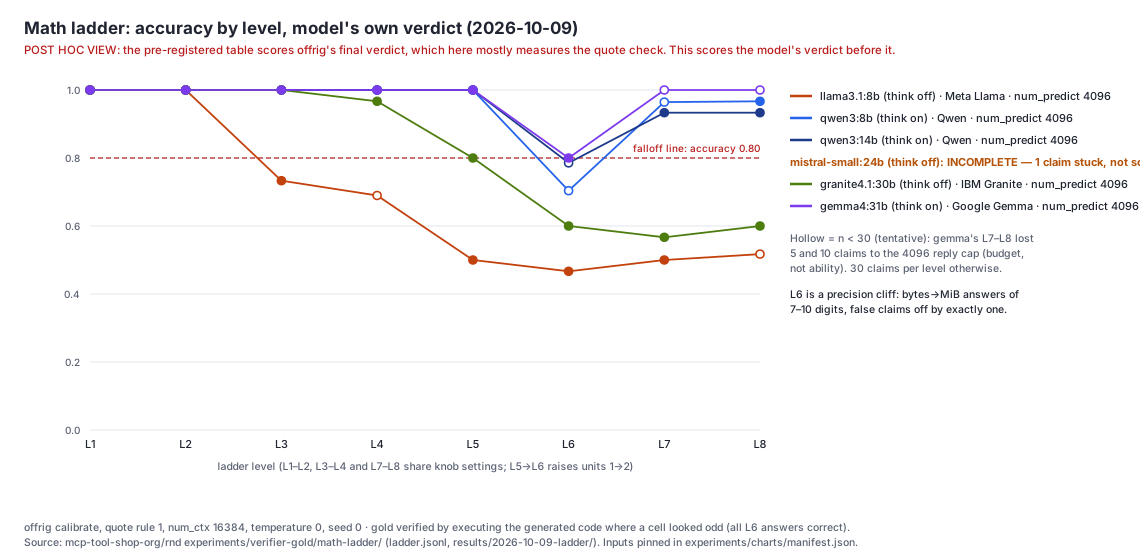
Section titled “What we found”- Three ways to fail. llama3.1:8b accepts: from level 5 it calls every false claim true. mistral-small:24b abstains. granite4.1:30b rejects true claims. The accuracy is similar, but the risk isn’t: for a verifier, accepting false claims is the dangerous failure.
- Thinking flattens the curve. Both qwen3 models and gemma4:31b are perfect through level 5.
- Level 6 is a precision cliff. Converting bytes to MiB makes 7–10 digit answers, and the false claims are off by exactly one. The thinking models accept 768937860 for 768937861.
- A cheap “check the last number” guard doesn’t help. It caught none of the qwen models’ 16 false accepts. Running the code is the sure check.
Caveats
Section titled “Caveats”- This chart scores the model’s own verdict, before offrig’s quote check. That is a post hoc view: the pre-registered table scores the final verdict, which on this ladder mostly measured the quote check (the code lines were shorter than its minimum quote length).
- mistral-small:24b’s run is INCOMPLETE: one claim stuck on a server error, so it isn’t drawn as a score.
- gemma4:31b ran at a 4,096-token reply limit, so its levels 7–8 lost claims to the limit. Those points are hollow: fewer than 30 claims, tentative.
Receipts
Section titled “Receipts”mcp-tool-shop-org/rnd, experiments/verifier-gold/math-ladder/: ladder.jsonl (the gold), report.py, and
results/2026-10-09-ladder/ (per-model runs and both report views).