
Why our critic refuses good drafts
The studio builds training data with local language models. A writer model drafts each item, and a critic model checks it. Many items end in a verdict about a short piece of material (a notice, a label, a code snippet) and a statement about it. There are three labels:
- supported: the material shows the statement is true;
- unsupported: the material rules it out;
- cannot_tell: the material says nothing either way.
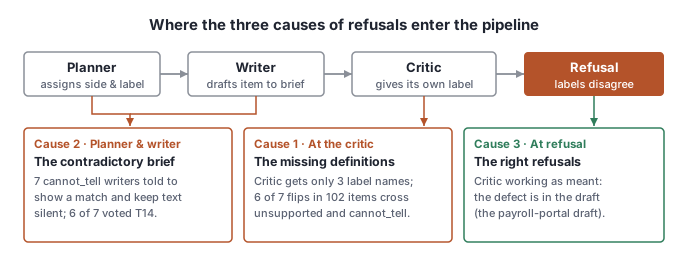
The writer is told which label its item should carry. The critic reads the material and the statement and gives its own label. When they disagree, the draft is refused. Each refusal costs a rewrite, and a refusal of a good draft also throws away a good item. In issue 21 the critic refused too many good items. This issue follows the refusals, and finds three causes.
Cause 1: the critic is never told what the labels mean
Section titled “Cause 1: the critic is never told what the labels mean”The writer’s instructions spell out what cannot_tell means. For a cannot_tell item, the writer reads: “The material must be silent on the statement: it neither shows it nor rules it out.”
The critic’s instructions name the three labels and nothing more. Its verdict request holds that instruction, the material and the statement. So where “silent” ends and “rules it out” begins is left to the critic’s own reading.
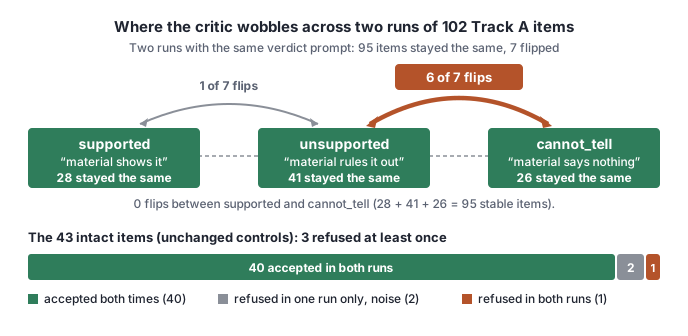
That’s the line where its answers wobble. An earlier study, Track A, ran the critic twice over the same 102 items on the same kind of GPU. As issue 27 found, the seed never reached the model in those runs, so each run sampled differently. The two runs disagreed on 7 of 102 verdicts, and 6 of the 7 were between unsupported and cannot_tell. The seventh went from unsupported to supported.
Track A also has 43 intact items, which the study’s design left unchanged as controls. Over the two runs, the critic refused 3 of them at least once. Two of those refusals happened in one run only, which is noise. The third was refused both times.
Cause 2: a brief that contradicts itself
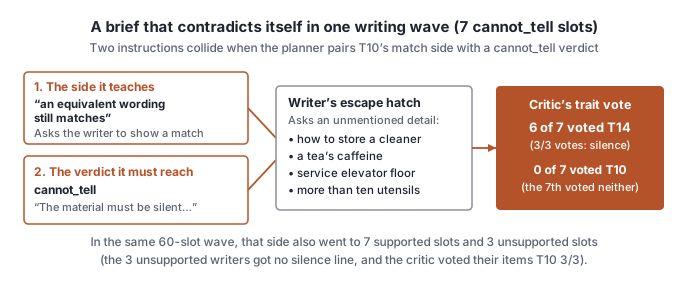
Section titled “Cause 2: a brief that contradicts itself”T10, the lesson in our pilot, teaches one thing: when a size, quantity or scope word in the statement differs from the material (“at least”, “exactly”, “every”), check the exact size the statement claims. Each slot in the plan also gets a side of that lesson to teach. One is “judges the exact size”. Another is “an equivalent wording still matches”: the statement says the same thing, phrased differently.
That second side can’t go with cannot_tell. If an equivalent wording in the material matches, the answer is supported. Yet in one writing wave of 60 slots, the planner gave that side to 7 cannot_tell slots and 3 unsupported slots. Each of the 7 cannot_tell writers was told both to show a match and to keep the material silent. The 3 unsupported writers weren’t given the silence line, and the critic voted their items T10 every time.
The critic also votes three times on which lesson an item teaches. Here’s what it said about the 12 cannot_tell slots:
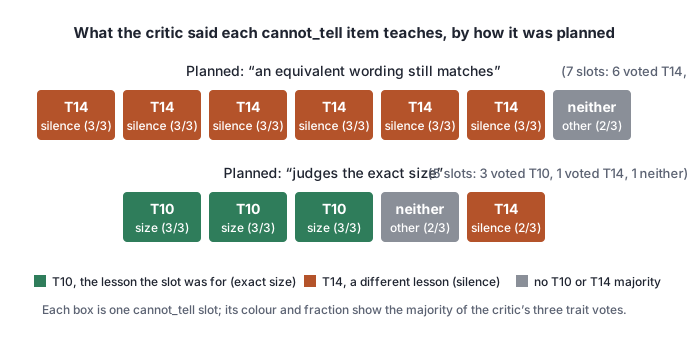
- Planned with “an equivalent wording still matches”: on 6 of the 7, all three votes said T14, a different
lesson: the material is silent on a detail, so don’t fill it in. The writer had escaped the contradiction by asking
about something the material never mentions:
- how to store a cleaner;
- a tea’s caffeine, on a label whose only quantity is its weight;
- which floor a service elevator is on;
- more than ten utensils, on a box label that lists “Utensils” with no count.
- Planned with “judges the exact size”: 3 of the 5 were voted T10 three times out of three. They have one shape: the material gives a loose amount (“a few items are redundant”, “several team members raised concerns”), and the statement claims an exact one (“exactly three”). The other 2 weren’t clean. One swapped the North Wing for the South Wing; the other stretched a week’s schedule over a month.
The fix in the planner is simple: never pair a verdict with a side it contradicts. A second fix is an option in the writer’s brief. It asks for that loose-versus-exact shape on T10’s cannot_tell items, and forbids swapped names and unmentioned topics. Both have been agreed but not built. The option will be tested against today’s brief before it becomes the default.
Cause 3: sometimes the critic is right
Section titled “Cause 3: sometimes the critic is right”Before measuring how often the critic wrongly refuses, we needed to know which items are sound. So we built a panel of 30 items, 10 for each label, and had them graded blind: the grader saw the material, the statement and the label definitions, with no stored label and no critic output.
Two graders worked separately: Antigravity, in a fresh conversation, and the R&D seat. An item counted as sound only if both graders and its stored label agreed, and neither grader flagged it as unclear. Anything else counted as ambiguous, with no tiebreak.
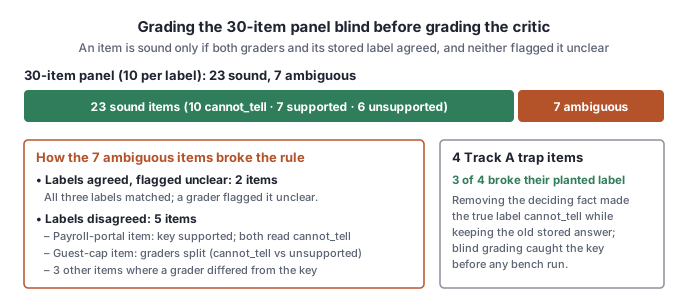
One ambiguous item shows the critic doing its job. Its stored label was supported, and the critic refused it. Both graders read cannot_tell. The statement named a payroll portal that the material never mentions. That draft’s flaw was the writer’s, and the critic was right to refuse it.
Another needs a judgment the definitions don’t settle. The material is a complete input check with no upper limit, and the statement says the code caps guests at 50. If that function is the whole check, the material rules the statement out. If it might be one piece of a larger system, the material is silent. The two graders split. No prompt change or vote can make an item like that stable, so the bench counts such items apart.
R&D had looked at three of the 30 items before grading, so its grades on those three weren’t blind. Two of them are among the 7 ambiguous ones.
A key file corrected before any run. Four panel items come from Track A’s traps. On 3 of the 4, both graders disagreed with the stored label. The reason was in the study’s design document, written four days earlier. Those items are deliberate traps: the deciding fact is removed, so the true label becomes cannot_tell while the stored label keeps the old answer on purpose. The panel builder had copied the stored label. The key file now holds the true one, and keeps the stored value alongside. The graders’ disagreement is what caught it.
A measure we tried: hesitation
Section titled “A measure we tried: hesitation”The critic thinks before it answers. We counted how often its thinking switches between the three labels, and called it hesitation. On the two Track A runs:
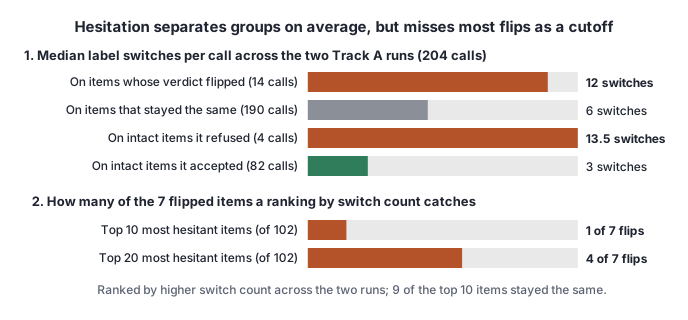
The gap is real, but hesitation is a weak alarm. The 10 most hesitant items held only 1 of the 7 flips, and the top 20 held 4. And it can only find doubts the critic writes down. A confident wrong refusal leaves no trace. So it’s useful as a hint, not as a gate.
How this was found
Section titled “How this was found”None of this came from a checklist. It came from an open research dialogue with Antigravity, the outside model we use for reviews. It began as follow-up questions on issue 27’s results. Antigravity lined the cannot_tell drafts up against the plan, and spotted both the contradictory pairing and the missing definitions. It also suggested the hesitation measure, and grading a sample blind. We checked each claim against the code and the run records. One list of item names it gave was wrong, though its count was right. The figures in this issue are ours, recounted from those records.
Antigravity also designed this issue’s charts and diagrams, over three rounds with the newsletter desk, which recounted every number in them from the same records.
What’s next
Section titled “What’s next”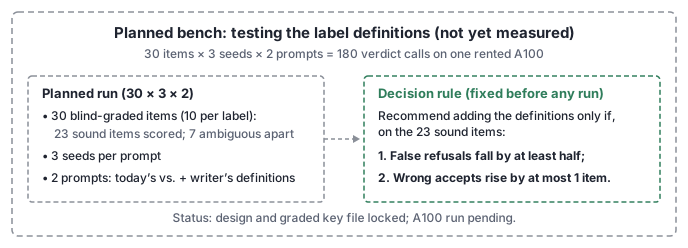
-
A 30-item bench. It runs on one rented A100, with each of the 30 items × 3 seeds × 2 prompts: today’s critic prompt, and the same prompt plus one sentence giving the writer’s definitions. The decision rule is fixed in advance:
- the definitions are recommended only if they cut false refusals on sound items by at least half;
- and they accept no more than one extra item whose sound label they contradict.
Not yet measured.
-
The planner fix and the writer-brief option. Agreed, not built. The option’s test measures two things: how often the critic votes T10, and how many drafts it accepts.
The raw notes, the bench design and the graded panel are in the studio’s research library, and will move into rnd with the bench’s results.
Get each issue by email or RSS: Subscribe