Experiments and receipts
Every experiment is pre-registered. Its spec under experiments/<id>/spec.yaml is committed, with the question, the decision it feeds, the arms, the dataset, the metrics, and the stop rules, before any device time. interlock run refuses a spec that was edited after its commit. The spec’s blob is checked against that commit before the run (require_unmodified) and printed by --dry-run. It is not written into the receipt. An E4b receipt records the harness git_sha and clean_tree. A fill-card receipt records experiment_spec and run_id, and when preflight ran it also records git_sha and clean_tree. Any other shared-runner receipt records experiment_spec and run_id only. By practice, a rule is not changed after results are seen. A dated amendment comes before the run whose results count. A run set aside as void is recorded as such.
What a receipt holds
Section titled “What a receipt holds”A routing row names the task, the model (repo or tag, revision or digest, quantisation, licence), the engine and its version, the device, the settings, and the quality and latency it measured. Quality metrics carry their own n, interval, and dataset hash. Latency keeps cold and warm apart. A single run is marked provisional. The row points at the source receipt and the commit it was imported from, or at an experiment spec and a run id.
A run can record a capability instead of a speed. device_lost and hang carry no timing. native_binary_rejected keeps only the compile time, and only arms with that same model, device, and static shape are marked not run. compile_timeout is a compile that ran past the ceiling. All of these are provisional and never count as speeds. The routing table also refuses aborted rows. table/gaps.md lists the aborted run.
Run lifecycle
Section titled “Run lifecycle”A run ends in one of two states.
A finished run leaves receipts/<run-id>.jsonl and, for E4b, its series beside it. A run that stops partway writes that receipt first, with the calls that finished and aborted: true, then moves the receipt, the series, the log, and the run marker into aborted/<run-id>-<sha>/ with a NOTE.json. aborted/ is gitignored. It is not a result: interlock import does not read it, and those runs never reach the routing table.
Every run also writes receipts/<run-id>.run.json before it touches a device. That marker is gitignored. A run killed from outside still leaves a record that it started. To stop a run cleanly from outside, create receipts/<run-id>.stop. The watcher flushes the receipt and exits 77.
interlock runs list shows complete, aborted, and stray. interlock runs quarantine <run-id> sets a stray series aside by hand. See Usage.
E1 asks, for each embed model on each Intel device, what a cold load costs in units of that arm’s own warm median call. The decision is a break-even count: compile of a warm reload, plus any extra in the first call, divided by the warm median. The keep-resident threshold is 100. The question is whether the router may treat a device, the NPU in particular, as warm-only. The spec is experiments/e1/spec.yaml. The receipts are the e1-intel-2026-10-09* files.
E2 asks whether Qwen3-Embedding-0.6B, as the pinned OpenVINO fp16 export, is a candidate embedder worth a retrieval-benchmark slot. It makes no retrieval-quality claim. Two gates have to pass: cosine parity of at least 0.999 against the CPU batch-1 arm at the same length, and a warm median on the NPU or the iGPU at batch 1 and length 512 that is at most 0.9 times the CPU warm median. The spec is experiments/e2/spec.yaml.
E3 and the 5090 reference
Section titled “E3 and the 5090 reference”E3 asks whether the Intel side can host an always-on small generator, and at what latency. Two channel-wise int4 models, Phi-3.5-mini and Qwen3-8B, run through OpenVINO on the NPU, the iGPU, and the CPU. The viability gate, chosen before any run, is 15 tokens per second or more at a 1024-token prompt with thinking off, on at least one model and one Intel device. The spec is experiments/e3/spec.yaml. The run notes are experiments/e3/run-notes-2026-10-10-11.md.
The README’s summary of those receipts: Phi-3.5-mini decodes at about 20 to 22 tokens/s on the CPU and the iGPU, and about 15 tokens/s on the NPU, at a 1024-token prompt with thinking off. Qwen3-8B at the same prompt decodes at about 10 to 12 tokens/s on the CPU, the iGPU, and the NPU.
E3-REF is the speed reference for that ratio, not a gate of its own. It measures qwen3:8b on the 5090 through Ollama at the 1024-token prompt, thinking off and on. The spec is experiments/e3-ref/spec.yaml. The README’s summary of that receipt: about 208 tokens/s with thinking off and 211 with it on. interlock route ranks by the worst repeat, so its choices are more cautious than these summaries.
Some shapes do not run. The NPU rejected Qwen3-Embedding at 512-token inputs, one at a time and in batches of 8. Those rows are capability findings, never ranked as slow candidates.
E4 asks the contention question that E4b later repeats: while qwen3:8b decodes on the 5090, does a sustained NPU embedding load or a sustained iGPU NLI load change that decode rate, and does the 5090 change the NPU or iGPU latency? E4’s rule compares paired medians with a band of 0.10, and it is valid only when the alone samples’ own spread is at most half the band. The spec is experiments/e4/spec.yaml. E4b’s rates are not comparable to E4’s. The prompt changed.
E5 asks, for each named local 5090 model, the largest num_ctx that stays fully resident and at or under 30500 MiB, including the peak while a long prompt is processed. A window that fails residency, spills, or exceeds that line steps back one 2048-token notch. Time to first token and decode tokens per second are recorded and are not gates. The spec is experiments/e5/spec.yaml.
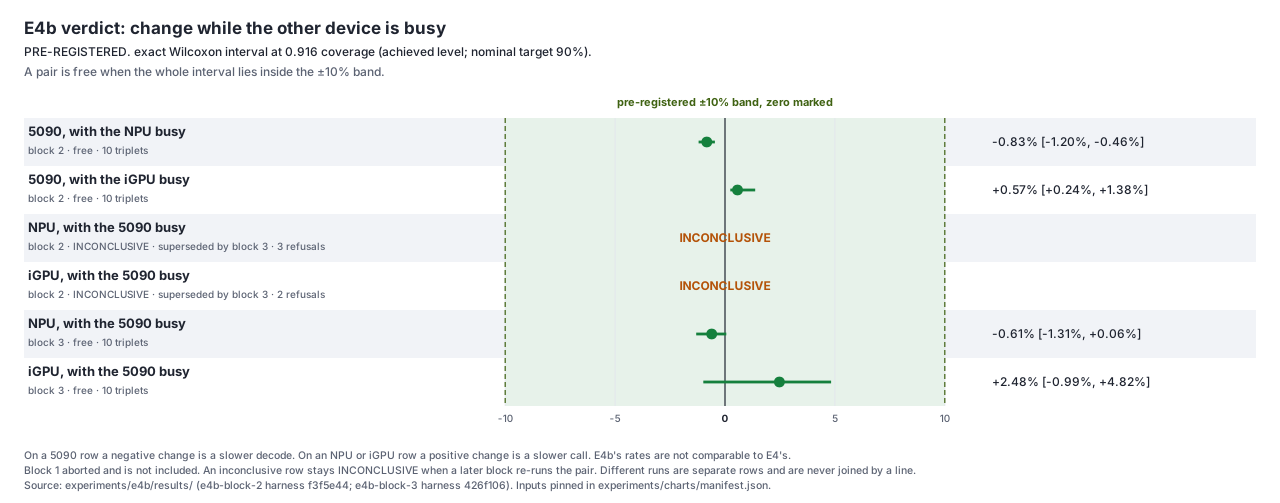
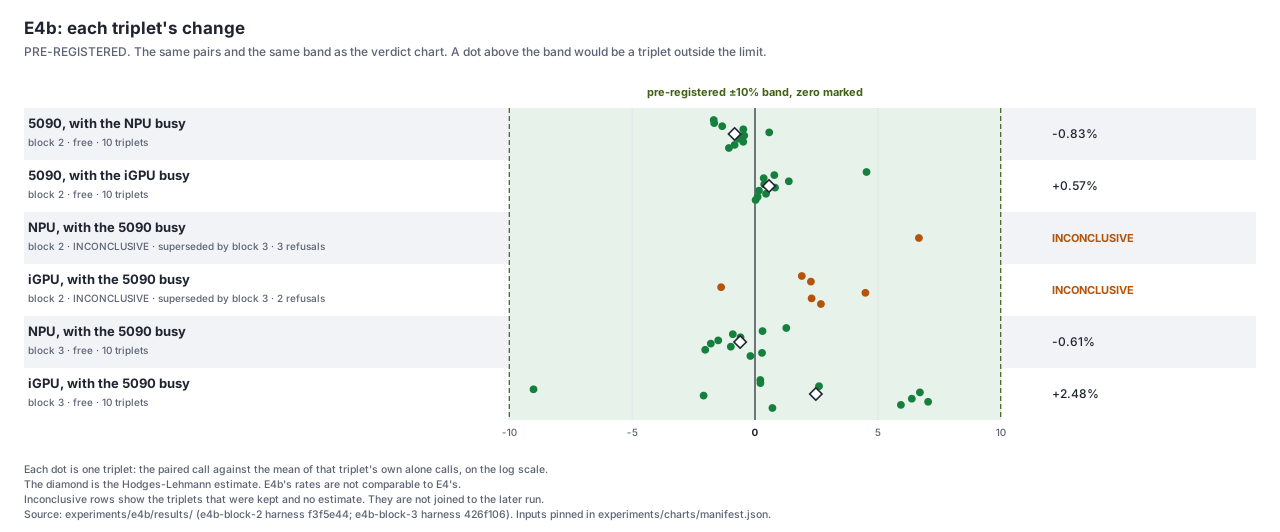
E4b asks E4’s question again, with a counting prompt shared by every arm and with the triplet as the unit of analysis. The spec is experiments/e4b/spec.yaml.
For triplet i the effect is the log ratio of the paired slot against the mean of that triplet’s own alone-before and alone-after. It is not a chain shared with the next triplet. The estimate is the Hodges-Lehmann estimate of those log ratios, with an exact Wilcoxon signed-rank interval. The interval used is the narrowest exact interval whose confidence is at least 90 percent. The achieved level is recorded on the receipt. A percentile bootstrap is a footnote and never decides.
The pair is free when the whole interval lies inside ±0.10 on the log scale, about 0.905 times to 1.105 times. A consistent speed-up is coupling too, so an interval that lies entirely outside the band on either side is not free. Anything else is inconclusive. An inconclusive pair is not a pass.
The sign depends on the device. For the 5090 the measurement is decode tokens per second, and a slower pair is negative. For the NPU and the iGPU the measurement is warm latency in milliseconds, and a slower pair is positive.
Two committed receipts hold the result. Percent below is 100 times the log ratio, to two decimals.
receipts/e4b-block-2.jsonl decided the two 5090-side pairs and left the Intel-side pairs inconclusive. Those two had refusal events and no interval. They are not hidden.
| Pair | Estimate | Interval | Verdict |
|---|---|---|---|
| 5090-npu | −0.83% | [−1.20, −0.46] | free |
| 5090-igpu | +0.57% | [+0.24, +1.38] | free |
| npu-5090 | none | none | inconclusive |
| igpu-5090 | none | none | inconclusive |
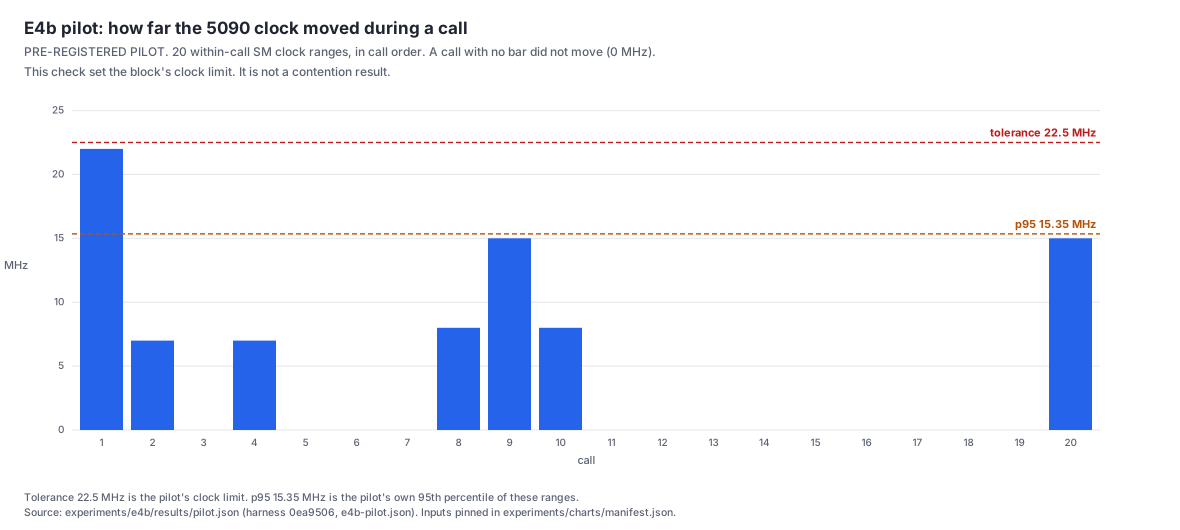
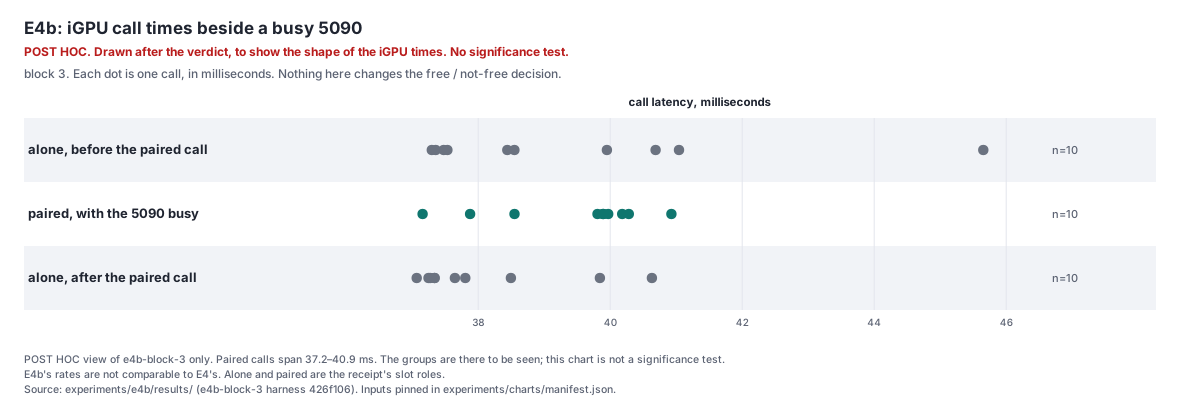
receipts/e4b-block-3.jsonl re-ran the two inconclusive pairs. Block 2’s Intel-side pairs were refused because the harness started the Intel calls before the 5090 companion was steadily decoding, which the spec already required. The dated amendment, written after block 2 and before block 3, made the harness wait for one steady warm decode. The band, the 22.5 MHz tolerance and the estimator did not change. Both intervals sit inside the band.
| Pair | Estimate | Interval | Verdict |
|---|---|---|---|
| npu-5090 | −0.61% | [−1.31, +0.06] | free |
| igpu-5090 | +2.48% | [−0.99, +4.82] | free |
On each decided pair the achieved coverage is 0.916015625. The method on the receipt is exact-wilcoxon-signed-rank. The band is 0.10.
In plain words: the four decided pairs are free under the rule that was written down before the runs. The router may schedule those pairs as independent lanes on that evidence. The two pairs that block 2 could not decide were run again, and the second run is the one that counts for them. Block 2’s inconclusive rows stay in the receipt.
The first live attempt did not leave a committed receipt. The committed blocks are block 2 and block 3.
rnd drew the charts from these receipts. They are up: